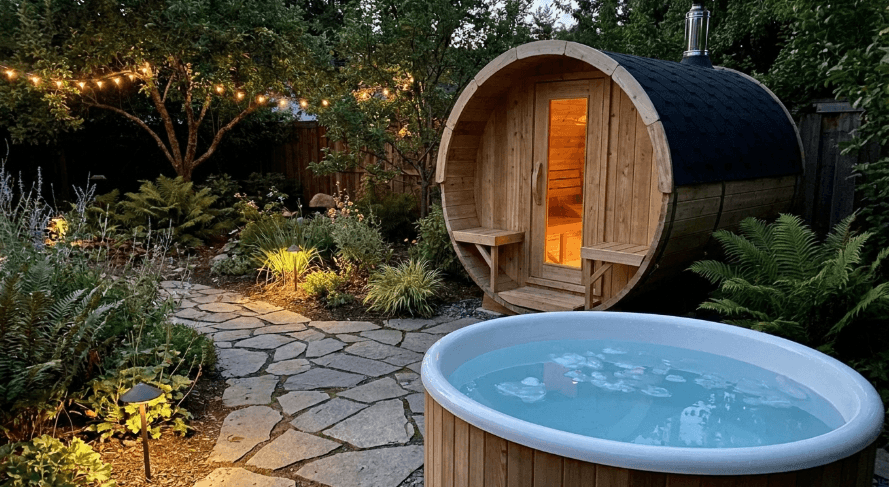
Cedar and heat-treated hemlock are the two woods most small-sauna builders choose between, and the short answer is that cedar gives a stronger aroma and a warmer look while heat-treated hemlock gives more dimensional stability and a lower price per board foot. In a four by six foot cabin, where every board is close to your skin and every seam is close to the heater, that stability difference matters more than it would in a large commercial sauna room.
What Is Heat-Treated Hemlock Exactly?
Heat-treated, or thermally modified, hemlock is regular hemlock lumber baked in a low-oxygen kiln at temperatures well above standard drying, usually somewhere between 380 and 440 degrees Fahrenheit. The process changes the wood’s cell structure, pulling out much of the sugar content that mold and insects feed on and reducing how much the board expands and contracts as humidity swings. The trade-off is that the wood becomes a bit more brittle and darker in color, closer to a light coffee tone than the pale blond of untreated hemlock.
How Does Cedar Compare on Performance?
Western red cedar has been the default sauna wood for generations for good reason. It runs light, stays cool to the touch even near the heater, and its natural oils give it real resistance to rot and insect damage without any thermal processing. Cedar also releases the scent most people associate with a sauna the moment water hits the rocks. The downside in a small cabin is that cedar is a softer wood, so benches take dents and scuffs more easily, and the board-to-board movement as the cabin heats and cools can open small gaps over a few seasons if the joinery was not tight to begin with.
Which Wood Handles a Tight, Humid Cabin Better?
This is where the size of the room starts to matter. A large sauna has enough air volume that minor board movement rarely becomes a problem. A small cabin heats and cools faster and holds a higher relative humidity per cubic foot during a session, which stresses joints more over time. Heat-treated hemlock’s lower moisture absorption, generally cited in the range of a 30 to 50 percent reduction in equilibrium moisture content compared with untreated softwood, gives it a real edge for keeping tongue-and-groove seams tight in a compact build. Cedar can still perform well in a small space, it just tends to need a slightly more careful build and a bit more seasonal attention to any gapping.
How Do the Two Woods Compare on Price?
Heat-treated hemlock generally runs cheaper than clear-grade cedar, sometimes by a wide margin depending on the supplier and the grade of cedar being compared. For a small four by five or four by six cabin, that difference can mean a few hundred dollars in material cost, which matters more on a compact build where the wood is a bigger share of the total budget than it is on a large custom room. Anyone comparing finished small units rather than building from raw lumber can see current pricing across wood types by browsing the SweatDecks catalog, where cost differences between wood options on ready-built cabins are listed side by side.
Which Wood Should You Pick for a Small Backyard Sauna?
If budget and dimensional stability matter most, heat-treated hemlock is the more forgiving choice for a compact cabin that will see daily use through humid summers and dry winters. If the classic look and scent of a traditional sauna matter more than saving on materials, cedar remains the benchmark and performs fine in a small space as long as the joinery is built tight and the cabin gets proper ventilation between sessions. Neither wood is a wrong choice, the decision comes down to whether you are optimizing for authenticity or for low-maintenance stability in a tight footprint.
How Does Each Wood Behave During Construction?
Builders working with cedar generally report it is easier to cut and fasten without splitting, since it is a softer, more forgiving softwood even along the grain near board ends. Heat-treated hemlock, having gone through a high-temperature process, is more brittle in places and can crack if a nail or screw goes in too close to an edge without a pilot hole, which matters more on a small cabin where boards are cut into tighter, more irregular shapes to fit around a bench frame or heater guard. Pilot-drilling every fastener point adds time to a build, but it prevents the kind of split boards that turn into wasted material on a project where every board foot already carries a real cost. Kiln-drying time before installation matters for both woods, and installers who skip an adequate acclimation period in either species tend to see more movement and gapping in the first year regardless of which wood they chose.
Are There Other Wood Options Worth Considering?
Basswood and thermally modified aspen show up occasionally as alternatives to cedar and hemlock, mostly for interior bench surfaces rather than full wall paneling. Basswood runs pale and stays relatively cool underfoot, similar in feel to cedar but with less natural oil content and less rot resistance, so it usually appears only on interior surfaces that are not exposed to weather. Thermally modified aspen shares hemlock’s dimensional stability benefits from the heat-treating process but is less widely stocked than treated hemlock in most regions, which can make it harder to source for a small custom build without special ordering.
Frequently Asked Questions
Is cedar or heat-treated hemlock better for a small sauna?
Both work well in a compact cabin. Cedar brings a stronger natural aroma and slightly softer wood, while heat-treated hemlock is more dimensionally stable in a tight enclosure and usually costs less per board foot.
Does heat-treated hemlock still smell like a sauna?
It has a faint toasted, slightly nutty scent from the heat-treating process rather than the strong cedar smell most people associate with a traditional sauna, which some owners prefer if they find cedar oils too strong in a small room.
Which wood handles humidity better in a small cabin?
Heat-treated hemlock has slightly lower moisture absorption after the thermal process, which can mean less swelling and gapping in a tight, humid enclosure than untreated softwoods, though both cedar and treated hemlock are considered suitable sauna woods.
Is cedar naturally rot resistant?
Yes, cedar contains natural oils that give it some built-in resistance to rot and insects, which is part of why it has been a standard sauna wood for decades, though it still needs the same ventilation care as any other interior sauna wood.
References
- Does the Combination of Finnish Sauna Bathing and Other Lifestyle Factors Confer Additional Health Benefits? A Review of the Evidence, Mayo Clinic Proceedings, 2023.
- Effects of heat and cold on health, with special reference to Finnish sauna bathing, American Journal of Physiology – Regulatory, Integrative and Comparative Physiology, 2018.
- Benefits and risks of sauna bathing, The American Journal of Medicine, 2001.